As we enter Genesis 18, we see Abraham sitting near his tent door. Verse 1 tells us it was in the heat of the day. Abraham was probably taking a break from the day's work to cool off. When he looked up, he saw three men standing opposite him. What does Abraham do? He ran over to greet them but he did more than greet them. He bowed down before them and called one of them "Lord." Abraham offers to wash their feet. Then, he finds Sarah and tells her to bake them fresh bread. According to the Believer's Bible Commentary, two of the men were angels and one of them was the Lord Himself. Abraham and Sarah worked quickly to prepare a meal for the men. Some scholars believe Abraham knew the identity of the three visitors. Whether he knew their identities or not, this type of hospitality was typical in the Middle East in those days.
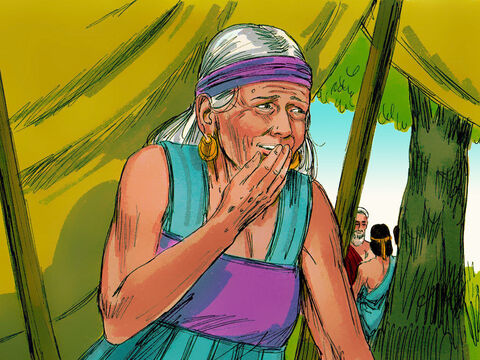
As the "men" were eating, they asked Abraham about Sarah, wondering where she was. While Sarah was in the tent, she heard one of the men tell Abraham that they would return at the same time next year. By that time, Sarah will have given birth to a son. Sarah laughed at the idea because she was well past childbearing years. The Lord (one of the men) asked Abraham why Sarah laughed. "Is there anything too difficult for the Lord?" the man asked.
Sarah denied that she had laughed because she was afraid, but the man (the Lord) said, "No, but you did laugh."
Can you imagine the scene? I actually kind of laugh to myself at this scene.
Sarah is in the tent doing her thing when she hears a man (she only knows him as a man) say she will have a baby by next year.
She laughs. Wouldn't you laugh if you were past childbearing years? I'm 52. If a strange man stopped by my house and told me that I would have a baby by next year, I promise you that I would laugh too. Sarah was 90!
The man (the Lord) asked her husband why she had laughed.
Sarah denied that she had laughed. I can imagine her response, "UH, no sir. I didn't laugh."
The man says, "Oh, but you DID laugh."
Sarah was busted.
Sarah was a woman of faith, but certainly we can understand her position. She was a 90 year old barren woman. I can understand the reason she reacted the way she did.
But God is faithful and true to His Word. Even in spite of Sarah's doubting, the Lord repeated His promises to Abraham and Sarah the he again said in verse 14, "At the appointed time I will return to you, at this time next year, and Sarah will have a son."
You can read the Biblical account of this passage at Bible Gateway here.
Later on in Genesis 21, God's promise to Abraham and Sarah is fulfilled as their son, Isaac, is born to them.
Teach the Kids
Here are several resources for teaching children the story about the Lord's promise to give Abraham and Sarah a son.
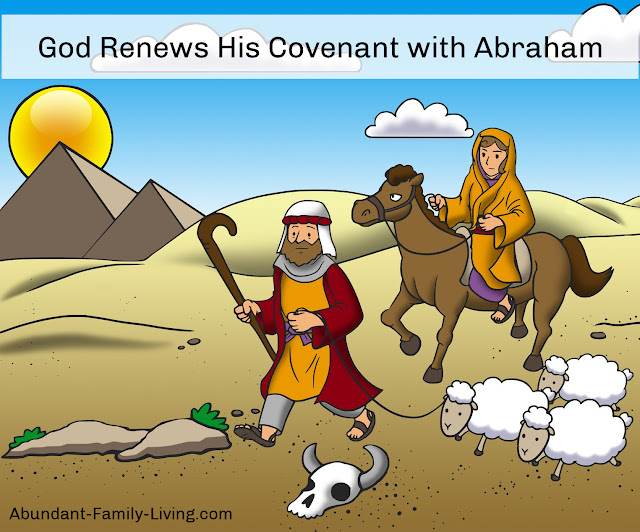
God renews His covenant with Abraham - Image Credit: JaymzArt - CCO Public Domain Image via Pixabay.
God Renews His Covenant with Abraham
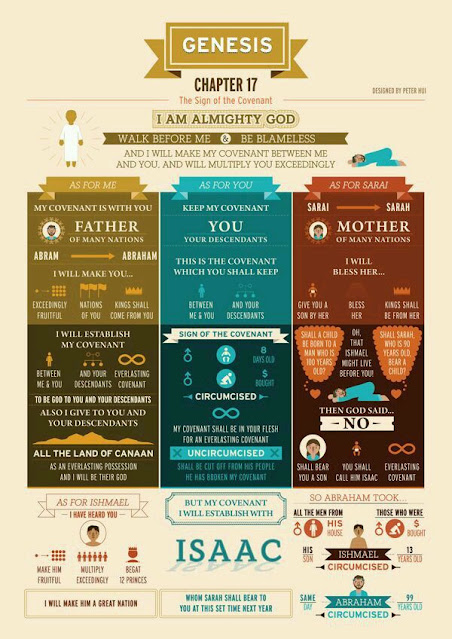
We learned in our last Genesis post that Sarai and Abram took matters into their own hands instead of trusting God's timing regarding His giving them a child. When Sarai and Abram followed through with Sarai's plan, problems ensued. As we enter Genesis 17, God renews His covenant with Abram. He then changes Abram's name to Abraham. Keep in mind that the name Abram means "exalted father" while the name Abraham means "father of a multitude." Circumcision was instituted here as a sign of the covenant between God and Abraham. Circumcision was a sign that the person belonged to God's chosen people on earth.
The Believers Bible Commentary has this to say about the topic of circumcision as it relates to God's covenant with Abraham:
"The Apostle Paul is careful to point out that Abraham was justified (15:6) before he was circumcised. His circumcision was “a seal of the righteousness of the faith which he had while still uncircumcised” (Rom. 4:11). Believers today are not sealed with a physical mark; they receive the Holy Spirit as a seal at the time of their conversion (Eph. 4:30)."
"But then the words 'circumcision' and 'circumcised' took on a variety of meanings. 'Uncircumcised lips' (Ex. 6:12) signified a lack of skill in public speaking. 'Uncircumcised ears' and 'uncircumcised hearts' spoke of failure to hear, love, and obey the Lord (Lev. 26:41;Deut. 10:16;30:6;Jer. 6:10;Acts 7:51). 'Uncircumcised in flesh' (Ezek. 44:7) meant unclean.
In the NT, 'the circumcision of Christ' (Col. 2:11) refers to His death on the cross. Believers are circumcised through their identification with Christ; Paul speaks of it as 'the circumcision made without hands, by putting off the body of the sins of the flesh' (Col. 2:11). This circumcision speaks of death to the fleshly nature. It is true positionally of every believer, but should be followed by a practical mortifying of the sinful deeds of the flesh (Col. 3:5). The apostle speaks of believers as the true circumcision (Phil. 3:3), in contrast to a party of Jewish legalists known as 'the circumcision' (Gal. 2:12)."
God not only changed Abram's name to Abraham (father of a multitude), but He also changes Sarai's name to Sarah which means "princess."
God then says to Abraham:
Then God said to Abraham, “As for your wife Sarai, you shall not call her by the name Sarai, but Sarah shall be her name.I will bless her, and indeed I will give you a son by her. Then I will bless her, and she shall be a mother of nations; kings of peoples will come from her.”
After hearing God's promise, Abraham makes a plea for Ishmael.
"Oh that Ishmael might live before You!"
God explains to Abraham that Ishmael will be fruitful and multiply. Ishmael will become a great nation, but God's covenant will be fulfilled through Isaac.
Something to note here again is the faithfulness of Abraham. Abraham obeyed God immediately (Genesis 17:23-27).
I found the following visual illustration of Genesis Chapter 17 on Pinterest.
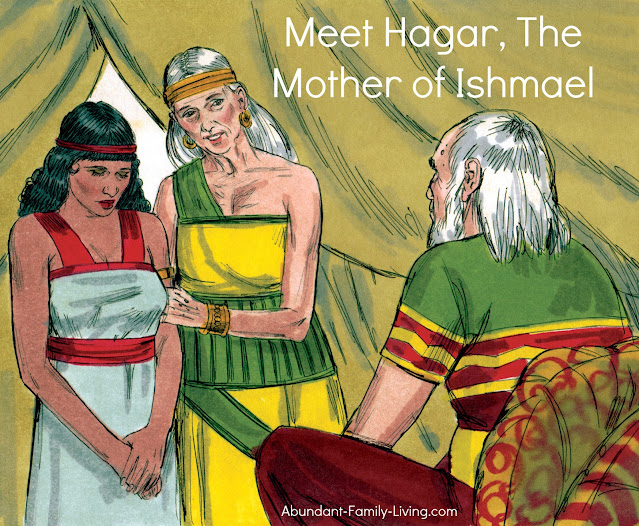
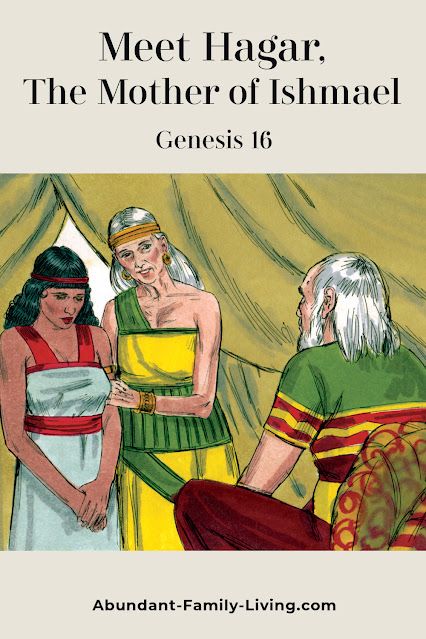
In Genesis 16, we meet a woman named Hagar. Hagar was a handmaiden of Sarai (later known as Sarah). Sarah had grown impatient while waiting on God to give her a child so she decided to wait no longer. She took matters into her own hands. She told her husband, Abram, to go to Hagar to sleep with her so that she could build a family through Hagar. This was a common practice in those times. Everything that belonged to the maidservants and/or slaves belonged also to their masters, even the children. Therefore, if Hagar had a baby, the baby would also be Sarai's baby. Abram did as he was told and Hagar conceived a baby.
When Hagar realized she was pregnant, she began to despise Sarai. When Sarai realized Hagar despised her, she blamed the whole thing on Abram. Then, she mistreated Hagar. She was so mean to Hagar that Hagar ran away.
An angel of the Lord found Hagar near a spring in the desert. The angel told Hagar to return to Sarai and then he made her a promise. He told Hagar that he would increase her descendants so much that there would be too many to count. Her son would be named Ishmael for God has heard Hagar's misery. Ishmael means "the God who hears."
Sarai called the Lord "The God Who Sees Me." The well where the Angel of the Lord spoke to Hagar is named Beer Bahai Roi which means "the well of Him who lives and sees me."
Hagar obeyed. I find this part interesting and inspiring. Hagar was pregnant by her mistress's husband. She had been badly mistreated. She had ran away. She's was probably exhausted, lonely, and afraid.
Yet she obeyed.
Life Lessons
1. Don't blame others for your bad decisions. Sarai blamed Abram for the soured relationship between herself and Hagar, but it was Sarai's idea for Abram to father a child by Hagar in the first place.
2. Be patient. Wait for the Lord. This all started because Sarai wasn't willing to wait on God. She took matters into her own hands and created a mess.
3. Remember that God is a God who hears.
4. Remember that God is a God who sees.
5. Be obedient. Hagar, in her condition, could have kept running, but she obeyed God and returned to the very place where she had been so badly treated.
Just as God heard and saw Hagar's misery, He hears and sees you too.
Right click and save this image as a free reminder that God sees you. Print it out and place it where you will see it often.
If you would like to learn more about Hagar and other women of the Bible, the good ones and the bad ones, I recommend Wicked Women of the Bible by Ann Spangler.
In my Coloring Through the Bible Series (using my Beautiful Word Coloring Bible), we are now brought to Genesis 13. At the end of Genesis 12, we read that Abram had lied about his relationship with Sarai so the Pharaoh had taken her as his own wife. This disaster resulted in famine in the land of Egypt. When the Pharaoh learned about Abram's deception, he sent them away. In fact, Pharaoh's words were "Now then, here is your wife. Take her and go!"
Abram and Lot
Now in Genesis 13, Abram traveled from Egypt up to the Negev. He took his wife and all his possessions. Abram's nephew, Lot, was also with him. We learn that Abram had become very wealthy. Abram went back to the place where he had been earlier, the place where he had first built an alter.
Abram called on the name of the Lord. (Genesis 13:3)
Lot had is own possessions but the land where they settled could not support Abram, Sarai, and all their possessions and also support Lot and all of his possessions.
Eventually, Abram's herders and Lot's herders began to argue with each other but Abram didn't want he and his nephew to argue. He didn't want their herders to argue either. Abram told Lot that there was plenty of land so if Lot would take his possessions to the right, Abram would take his to the left or if Lot wanted to take his possessions to the left, Abram would take his to the right. So they separated.
Lot chose the whole plain of the Jordan toward the East which was great land but it was not far from the city of Sodom where the people were evil and were sinning greatly against God. Abram settled in the land of Canaan.
After Lot left Abram, God said to Abram:
"Look around from where you are, to the north and south, to the east and west. All the land that you see I will give to you and your offspring forever. I will make your offspring like the dust of the earth, so that if anyone could count the dust, then your offspring could be counted. Go, walk through the length and breadth of the land for I am going it to you."
So, Abram went to live near the trees of Mamre at Hebron. There, he built an alter to the Lord.
Do you see a pattern with Abram? Abram was always faithfully calling on the name of the Lord and wherever he lived, he built an alter to the Lord. Abram was faithful to his God.
Here is a short lesson for adults about how this story of Abram and Lot relates to selfishness.
Let's go back to Lot for a minute or two. Remember that Lot had settled near the city of Sodom where the people were wicked and sinful. In the beginning of Genesis 14, we learn the there had been a 13 year war in the area. The region had been subject to King Kedorlaomer for 12 years. In the 13th year, some of the kings rebelled. In the 14th year, King Kedorlaomer and those allied with him defeated the Rephaites in Ashteroth Karnaim, the Zuzites in Ham, the Emites in Shaveh Kiriathaim, and the Horites in Seir. Then they turned back and went to Kadesh and conquered the whole area of the Amalekites as well as the Amorites in Hazezon Tamar. Then the king of Sodom, the king of Gomorrah, and the king of Admah, the king of Zeboyim, and the king of Bela marched and drew battle lines in the valley of Siddim against King Kedorlaomer, King Tidal, King Amraphel, and King Arioch (4 kings against 5).
One Side:
King Amraphel of Shinar
King Arioch of Ellasar
King Kedorlaomer of Elam
King Tidal of Goyim
Other Side:
These forces had been subject to King Kedorlaomer but in the thirteenth year, they rebelled.
King Bera of Sodom
King Birsha of Gomorrah
King Shinab of Admah
King Shemeber of Zeboyim
King Zoar of Bela
The kings of Sodom and Gomorrah fled. As they did so, some of their men fell into tar pits which were plentiful in the valley of Siddim. The rest of their men fled to the hills. The four kings allied with King Kedorlaomer seized all goods in Sodom and Gomorrah.
They also carried off Abram's nephew, Lot, and all of Lot's possessions. Remember that Lot was living near Sodom.
At least one man escaped who ran to tell Abram about Lot's predicament. Abram gathered 318 trained men who had been born in his household. They traveled as far as Dan. During the night, Abram divided his men and prepared to attack the kings who had taken Lot. Abram and his men followed the kings and their men as far as Hobah which was located north of Damascus.
Abram defeated the kings, received all the goods, and rescued his nephew, Lot, and his household.
After Abram had defeated the kings allied with King Kedorlaomer, the king of Sodom went to meet Abram. Then the king of Salem and a priest of God, King Melchizedek, brought our bread and wine and blessed Abram saying:
"Blessed be Abram by God Most High
Creator of Heaven and Earth
And praise be to God Most High
Who delivered your enemies into your hand."
Then Abram gave King Melchizedek a tenth of everything.
The king of Sodom wanted Abram to give him the people and for Abram to keep the goods but Abram responded:
"With raised hand I have sworn an oath to the Lord, God Most High, Creator of Heaven and Earth, that I will accept nothing belonging to you, not even a thread or the strap of a sandal, so that you will never be able to say, 'I made Abram rich.' I will accept nothing but what my men have eaten and the share that belongs to the men who went with me - Aner, Eshkol, and Mamre. Let then have their share."
It is after this that God makes a covenant with Abram. God tells Abram:
"Do not be afraid, Abram.
I am your shield,
Your very great reward."
At the time, Abram had no children so his only heir was one of his servants, Eliezer of Damascus. But God told Abram:
'This man will not be your heir, but a son who is your own flesh and blood will be your heir. He took him outside and said, 'Look up at the sky and count the stars - if indeed you can count them.' Then God said to Abram, 'So shall your offspring be."
Abram believed the Lord and he credited it to Him as righteousness.
In the rest of Genesis 15, God tells Abram that for four hundred years, his descendants will be strangers in a county not their own. In that land, they would be enslaved and mistreated. But God assures Abram that He will punish the nation that enslaves his descendants and that eventually they would come out with great possessions. God promises Abram that he will go to his ancestors in peace and die at a good old age. God promised Abram that He would give his descendants the land from the Wadi of Egypt to the great Euphrates river - the land of the Kenites, Kenizzites, Kadmonites, Hittites, Perizzites, Rephaites, Amorites, Canaanites, Girgashites, and Jebusites.
Teach the Kids!
Here is a short lesson for kids about how the story of Abram and Lot relates to selfishness.
Do your kids love to color? You'll find free Abram and Lot coloring pages here at Coloring.WS, a DLTK site for kids.
Coloring Through the Bible, Genesis 13-14, Abram and Lot
Abram and Lot: Genesis 13-14
After Pharaoh sent Abram and Sarai away with all their possessions, Abram, Sarai, and Lot went back to the area between Bethel and Ai. This is the place where Abram had first built an alter to the Lord. As was true to Abram's custom, he called on the name of the Lord.
In Genesis 13:1-4, Abram returns to Bethel where he had previously built an alter. If you have ever strayed from God, you can return to fellowship with Him. Isn't that comforting?
Lot, Abram's nephew, had been traveling with Abram. Both men had acquired a large amount of possessions, so great that the land would not support them. On top of that, Abram's herders and Lot's herders were arguing with each other.
Abram valued his family relationship with Lot. He didn't want quarreling so he told Lot to take the land either to the right or to the left. Abram would take his family and possessions in the opposite direction. Lot chose to go east to the whole plain of the Jordan because it was well watered. Abram chose to live in the land of Canaan. Lot's land was near Sodom where the people were wicked and sinned greatly against God.
After Lot left Abram, God told him:
"Look around from where you are, to the north and south, to the east and west. All the land you see, I will give to you and your offspring forever. I will make your offspring like the dust of the earth, so that if anyone could count the dust, then your offspring could be counted. Go, walk through the length and breadth of the land, for I am giving it to you." - Genesis 13:14-17
Abram chose to go to Hebron. Then guess what he did?
Abram built an alter to the Lord.
The beginning of the 14th chapter of Genesis describes warring between 9 kings in the region where Lot lived, near the lands of Sodom and Gomorrah. Four kings eventually seized all the goods of Sodom and Gomorrah, including Abram's nephew, Lot, and all of Lot's possessions.
A man escaped and reported the situation to Abram. Abram gathered 318 trained men to go after Lot. Abram succeeded. He brought Lot and Lot's possessions as well as the women and other people.
Melchizedek, king of Salem, went to Lot. Melchizedek was a priest of God and he blessed Abram saying:
Blessed be Abram by God Most High,
Creator of Heaven and earth.
And praise be to God Most High,
Who delivered your enemies into your hand. - Genesis 14:19-20
Abram gave Melchizedek a tenth of everything.
The king of Sodom wanted Abram to give him the people back, but told Abram that he could keep the goods for himself.
However, Abram told the king of Sodom that he had taken an oath to the Lord that he would take nothing belonging to the king of Sodom so that the king of Sodom could not claim to have made Abram wealthy. Abram only asked for the food his men had eaten and the share that belonged to the men who had gone with Abram.
I recently learned that there is a belief that Lot was not Abram's nephew but his brother instead. Roger Patterson at Answers in Genesis explains here that Lot was both Abram's nephew and his brother. Lot was Abram's nephew biologically, but Lot was considered Abram's brother because he was a member of the family of Terah.
Charles Stanley teaches two a life lessons based on Genesis 13:8 and Genesisi 14:20 He reminds us that:
Abram counted a good relationship with his nephew as more
important than his own material prosperity. He didn’t have to worry
about his possessions because he had seen that no one can ever outgive
God. (Charles Stanley Life Principles Daily Bible)
The mysterious priest Melchizedek reminded Abram that God had
given him the victory. Even though it was Abram’s men that did the
fighting, God was the one who was in control, and He is the author of
all blessings. (Charles Stanley Life Principles Daily Bible)
John MacArthur tells us concerning Genesis 13:8:
Abram’s whole reaction in resolving the strife between the two
households and their personnel portrayed a different Abram than seen in
Egypt; one whose attitude was not self-centered. Waving his right to
seniority, he gave the choice to his nephew, Lot. (The NKJV MacArthur Study Bible, 2nd Edition)
Regarding Genesis 13:9, MacArthur says:
Abram gladly called on Lot to select for himself what he desired for his household and flocks. After Lot’s choice had
been exercised, then Abram would accept what was left for him. Perhaps
this did much to restore, in the eyes of the servants, Abram’s integrity
and reputation. (The NKJV MacArthur Study Bible, 2nd Edition)
If you are teaching children the story of Abram and Lot, you can download and/or print coloring pages from DLTK here.
Since I've been digging deeper into Genesis and all the Bible stories I've read since childhood, genealogy records have been particularly interesting. In the past, I've always skipped over those passages. We are now in Genesis 11-12. Genesis 11 traces the genealogy from Shem (one of Noah's three sons) to Abram (who will later be called Abraham).
Geneses 11:27-32 tells us more about Terah's family line.
Family lines can get a bit confusing. No wonder I've always skipped over these parts in the past. However, it has been particularly interesting to me as I have traced the genealogy from Adam all the way to Abram.
Chapter 11 is all about the family lines as they are represented in the two charts above. Now we are ready to move on to God's promises to Abram in Genesis 12.
God's Promises to Abraham and Sarah
The Lord had said to Abram, “Go from your country, your people and your father’s household to the land I will show you.
“I will make you into a great nation, and I will bless you; I will make your name great, and you will be a blessing. I will bless those who bless you, and whoever curses you I will curse; and all peoples on earth will be blessed through you.”
So Abram went, as the Lord had told him. - Genesis 12:1-4
Have you noticed a particular repeated phrase regarding Noah's response to God's instructions and Abram's response? They both did as the Lord told them. This should be a good example for us. How many times have we chosen to not do as God has told us? Perhaps we deliberately disobeyed God's instructions or perhaps we ignored them. Then later on, we look back and realize that we should have followed the examples of Noah and Abram. We should have done exactly as the Lord told us.
The story goes on to tell us that Abram took his wife Sarai (later to be called Sarah), his nephew Lot, all their possessions and people they had acquired, and set out from Herran to travel to the land of Canaan. Then God gave Abram another promise.
To your offspring, I will give this Land. - Genesis 12:7
After God's promise to give to Noah's offspring the land of Canaan, Abram built an alter to the Lord and called on His name.
Then Abram continued on toward Negev.
According to BibleRef.com, the Negev (referred to as Negeb on their website), was a dry, desert area. It was not a good place for food or other resources.
There was a famine in the area of the Negev so Abram traveled to Egypt. It was so severe that Abram had to live in Egypt for a while. I took a photo of the bottom half of a map in the back of my NASB large print Bible so you can see the area we are reading about. (Genesis 12:10)
As Abram traveled from the Negev into Egypt, we come to another familiar Old Testament story. The Bible tells us that Abram knew the Egyptians would notice that Sarai was a beautiful woman. The Egyptians were sure to realize that Sarai was Abram's wife. Abram believed that the Egyptians would kill him, but let Sarai live so he convinced Sarai to pretend to be Abram's sister.
When Abram and Sarai arrived in Egypt, the Pharaoh's officials saw her and praised her to Pharaoh. Sarai was taken to Pharaoh's palace. Because Sarai was beautiful and thought to be Abram's sister, Abram was treated well. He acquired sheep and cattle, male and female donkeys, male and female servants, and camels.
However, God inflicted Pharaoh and his household with serious diseases. Pharoah knew something was wrong so he sent for Abram to ask him what he had done. When Pharaoh learned that Sarai was actually Abram's wife, he knew why he and his household had been inflicted with disease for he had taken Sarai as his own wife (Genesis 12:19). Pharaoh ordered Abram to take Sarai and go. Pharaoh's men were ordered to see that Abram, Sarai, and all that they had went away. (Genesis 12:10-20)
Lies always get someone in trouble don't they? It seems on the surface that Abram had a good reason for asking Sarai to lie about her relationship with him. Under similar circumstances, we might do the same thing. However, one lie can lead to disaster. Because of Abram and Sarai's lie, Pharaoh took Sarai as his own wife. He took the wife of another man as his own. Here is where the seemingly "innocent fib" resulted in disaster.
We should remember this story as an example about how a lie, even a seemingly innocent little fib, can and probably will result in disaster either for us or for someone else.
Do you wonder if the diseases inflicted upon Pharaoh and his family were unfair? I did at first because Pharaoh didn't know that Sarai was Abram's wife. Dr. Elizabeth Mitchell has written an article about this over at Answers in Genesis. She brings up a few points that had not crossed my mind. Also, I must have missed this point somewhere in my reading, but I didn't realize that Sarai was Abram's half sister. Abram didn't exactly lie, but he didn't tell the whole truth either. Another point she raises in her article is that as Abram's wife and also the mother of the nation God promised to Abram and Sarai, Abram failed to protect Sarai as he should have. Therefore, God stepped in to intervene in their circumstances.
Abraham was married to his half-sister, Sarai, who, at age
sixty-five, was still apparently beautiful. To protect himself, Abraham
persuaded Sarah to lie about her marriage to him and pretend to be his
sister. Unprotected by her husband, Sarah was whisked off to Pharaoh’s
harem. In exchange, Pharaoh showered Abraham with riches. Since Abraham didn’t properly protect Sarah, who was the promised
mother of a new nation that would bless the whole world, God had to step
in to keep her away from Pharaoh’s bed.
God protected Sarah by sending “great plagues” on Pharaoh and his
house. The Hebrew words translated as “plagues” can refer to sores or
wounds and does not require them to be deadly. Sarah was kept safe and
it seems Pharaoh eventually put two and two together and figured out
that the timing and scope of this disease was somehow associated with
Abraham’s arrival and that Sarah was Abraham’s wife. Pharaoh graciously
let Abraham keep all the stuff he had acquired in Egypt and summarily
sent him away. - Dr. Elizabeth Mitchell, Answers in Genesis.
Head over there here to read her full explanation. It's quiet an interesting read.
This post is part of my Coloring Through Genesis Series. I'm using my Beautiful Word Coloring Bible. I have enjoyed coloring the pages. I've always been a tactile learner so coloring the pages help me engage with the scriptures and I spend more time in the passages. If you think this is something you would like to do, grab a set of colored pencils and a Beautiful Word Coloring Bible. There are a few different variations of the Beautiful Word Coloring Bible.
As I was searching for credible online resources for you to teach the story of Abram and Sarai to your children, I came across Free Bible Images. It's a website that allows you to download their images for teaching Bible stories. It's awesome. Their images fall under the Creative Commons license. If you use them on a website or blog, you must give credit and link back to their site.
They give you a snippet of the story with the slides.
As they entered Egypt Abram became worried. His wife Sarai was very
beautiful. He feared that Pharaoh might kill him so he could take Sarai
as his wife. So, he told Sarai to pretend she was not his wife but his
sister. – Slide 14
Pharaoh’s officials told Pharaoh how beautiful Abram’s ‘sister’ was and
he took her into his palace. He gave Abram cattle, donkeys servants and
gifts. – Slide 15
If you would like to follow along with me as I journey through Biblical history in chronological order, subscribe here. I promise to not spam your inbox. :)
What happened to Noah and his family after they exited the ark onto dry ground? God established a covenant with Noah and his sons. God promised Noah that He would never again destroy the whole earth by flood waters. Then, God told Noah and his sons to be fruitful and multiply the earth. The rainbow that we often still see after a rainfall today was given as a sign for us to remember God's covenant with Noah.
As for you, be fruitful and increase in number; multiply on the earth and increase upon it. - Genesis 9:7
Then God said to Noah and to his sons with him:“I now establish my covenant with you and with your descendants after youand
with every living creature that was with you—the birds, the livestock
and all the wild animals, all those that came out of the ark with
you—every living creature on earth.I establish my covenant with you: Never again will all life be destroyed by the waters of a flood; never again will there be a flood to destroy the earth.”
And God said, “This is the sign of the covenant I am making between me and you and every living creature with you, a covenant for all generations to come:I have set my rainbow in the clouds, and it will be the sign of the covenant between me and the earth.Whenever I bring clouds over the earth and the rainbow appears in the clouds,I will remember my covenant between me and you and all living creatures of every kind. Never again will the waters become a flood to destroy all life.Whenever the rainbow appears in the clouds, I will see it and remember the everlasting covenant between God and all living creatures of every kind on the earth.”
So God said to Noah, “This is the sign of the covenant I have established between me and all life on the earth.” - Genesis 9:7-17
Noah's three sons were Shem, Ham, and Japheth. In Genesis 9:19, we learn that all the people who have populated the earth came from these three sons of Noah.
The family tree which outlines the descendants of Noah is called The Table of Nations.
The Table of Nations
Noah's Sons and Grandsons
Some of the Sons and Grandsons (Nations) of Japheth
Some of the Sons and Grandsons (Nations) of Ham
We
learn in chapter 10 of Genesis that Noah's great grandson, Nimrod, was the
builder of Nineveh. Before that, the city of Babylon was the first
center of his kingdom. Babylon's ruins are in modern day Iraq.
The Canaanites were also descendants of Ham. They were scattered to Gaza and Sodom and Gomorrah.
I've
never before studied the genealogy of Noah's descendants in detail. I
have found this chapter much more interesting than I had anticipated.
Some of the Sons and Grandsons (Nations) of Shem
Noah's obedience was really something, wasn't it? He did exactly as God had commanded him to do. Because of Noah's obedience, he and his family were saved from the flood waters along with a number of animals. Because of Noah's obedience, God made a covenant with Noah. God promised Noah that He would never again destroy the whole earth by flood waters. God said that He would put a sign, a rainbow, in the sky. Whenever we see a rainbow, we are to remember the covenant God made with Noah and his sons. God kept his promise to Noah.
Then God told Noah and his sons to be fruitful and multiply the earth. Let's read this part again.
And God said, “This is the sign of the covenant I am making between me and you and every living creature with you, a covenant for all generations to come:I have set my rainbow in the clouds, and it will be the sign of the covenant between me and the earth.Whenever I bring clouds over the earth and the rainbow appears in the clouds,I will remember my covenant between me and you and all living creatures of every kind. Never again will the waters become a flood to destroy all life.Whenever the rainbow appears in the clouds, I will see it and remember the everlasting covenant between God and all living creatures of every kind on the earth.”
So God said to Noah, “This is the sign of the covenant I have established between me and all life on the earth.” - Genesis 9:12-17
Since childhood, I've been reading the story of Noah's Ark. It's a popular story even in the secular world. It is common to see a painting or print of Naoh, the Ark, and many animals hanging on the walls of pediatric doctor's offices, daycare centers, and even in some public schools. The story of Noah is a story enjoyed by children, but it is also a story for adults.
The story of Noah is a story about obedience. It's a story about a man who did exactly as God told him to do even if it didn't make sense to him. Movies often depict Noah's friends and neighbors as people who made fun of Noah. Unless I missed something, there is no record of people making fun of Noah in the Bible, not in Genesis 6-10. However, the people of the day were wicked so I imagine that those around Noah probably thought he was crazy. I think it is safe to say that people probably made fun of Noah daily. He was a righteous man surrounded by so much evil that God regretted having created humans - and he was building a giant boat - on dry land - in obedience to a God in whom the others did not believe, or at least they did not honor God.
Noah's example of obedience is one of which both children and adults should play close attention. God honored Noah's obedience by saving not only Noah, but also his family. Then, it was Noah's family who repopulated the earth and built nations. This story is also a reminder to us that God keeps His promises.
I hope that if I ever find myself standing alone in obedience to God, that I would follow Noah's example of full obedience.
Coloring Through Genesis
This post is part of my Coloring Through Genesis Series.
It is easy to find stories of Noah's Ark for children. First of all, read them the story from the Bible. Make sure your children know the story of Noah is in the Bible, a story not just about a boat filled with animals, but a story about obedience and faithfulness to God. Teach your children to always remember that God always keeps His promises.
Piece together a wonderfully illustrated 30-piece jigsaw puzzle to
complete the breathtaking picture of Noah's Ark, illustrated by John
Joven, taken from the hugely successful picture book, also featured in
this gift set. Puzzle measures 14 x 14 inches when completed. Check it out here!